
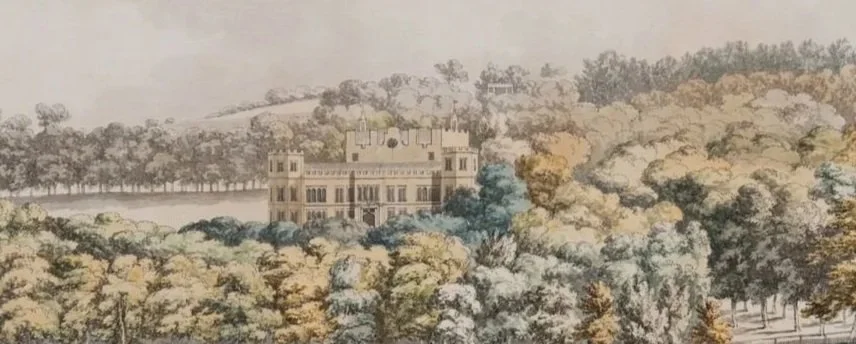
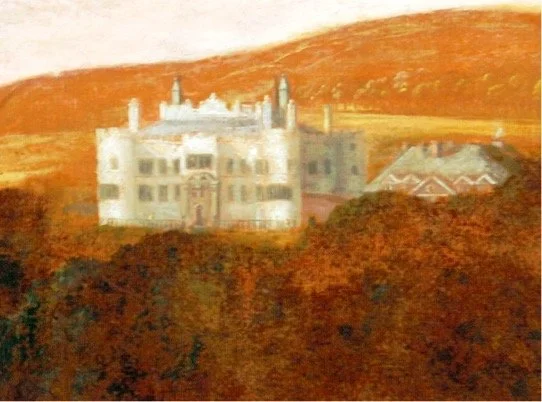
Mount Edgcumbe House, as depicted in the Edgcumbe Panorama, Charles Tomkins 1778-79
History
The history of the Mount Edgcumbe parkland and the remarkable family who created it over several centuries is fascinating and remarkable, encapsulating as it does key events in the rise of the Tudor dynasty, the period of assertive Cornish identity, the anguish of the civil war, the flowering of the Renaissance, the fuelling of the industrial revolution and the decline of landed estates after the Great War.
For an overview of key historical events see the
Chronology
Shell Seat in the Earl’s Garden, built ca. 1770 © M. Corber 2023
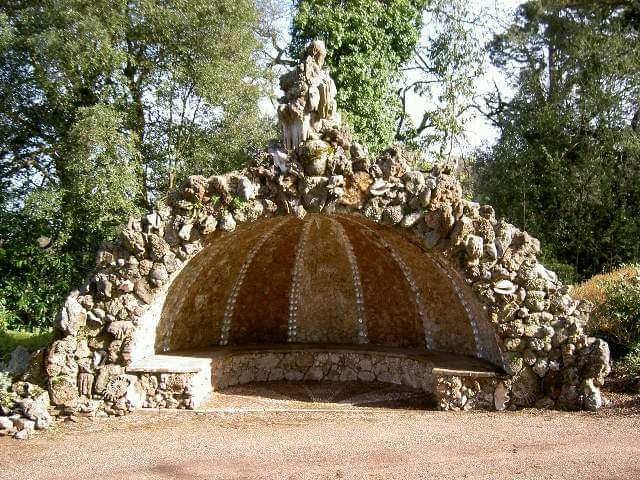
Shell Seat in the Earl’s Garden, built ca. 1770 © M. Corber 2023
Shell Seat in the Earl’s Garden, built ca. 1770 © M. Corber 2023
The early years
What we now know as the Mount Edgcumbe Country Park started off as a deer park, enclosed by Sir Piers Edgcumbe in 1515. Sir Piers Edgcumbe had acquired the land on the Rame peninsula when he married Joan Durnford in 1493, and it was he who bestowed the name Mount Edgcumbe on the eastern end of the Rame peninsula. The main seat of the Edgcumbe family was then at Cotehele, higher up the Tamar river. After inheriting the estate in 1539, Sir Piers’ son Richard built a house on the site. Initially, this was used as a hunting lodge and contemporary accounts speak of the prodigious coneys (rabbits) and the plentiful deer, which roamed right up the house. The house became the Edgcumbe family’s main residence. \
The Edgcumbe family estate was once very large indeed. By 1671, when Sir Richard Edgcumbe, the father of the first Lord Edgcumbe, married Lady Anne Montague daughter of the Earl and Countess of Sandwich, he owned the mansion house and barton (farm) of Bogrugan near St Austell with 500 acres and approximately a dozen other manors and farms further into Cornwall, as well as lands, manors and houses in Maker, Mount Edgcumbe with its deer park, Cotehele with its house, park and farm, lands in Sussex, 400 acres at Ashey near Ryde in the Isle of Wight and, of course, the Cremill (Cremyll) Ferry, most of Stonehouse and a considerable number of tin mines and smelting works. Two hundred years later in the late 19th century, the Earl of Mount Edgcumbe was the owner of more than 18,000 acres of land, the third largest holding by a Cornish family estate, although by then a quarter by area was in Devon and tin and other mining operations produced a very significant proportion of total income.
This prosperity allowed for the development, over three centuries, of pleasure grounds, plantations and rides in the parkland. No landscape architect or gardener was employed to oversee the whole. And as landscape historian Kate Feluś comments, Mount Edgcumbe is unusual in that elements of the landscape have expanded further and further outwards. In many other locations, layers of design typical of a certain period have tended to be overwritten by designs favoured in subsequent periods. The result is that within the Mount Edgcumbe Country Park, certain elements of key periods remain relatively intact.
Throughout its history, from the 16th through to the mid-20th century, the design and setting of Mount Edgcumbe was greatly admired and lavishly praised. Royals and other dignitaries from near and far queued to visit.
LINK TO MINING HISTORY LINK TO PALL MALL ARTICLE
Landing craft and US troops at Barn Pool in Mount Edgcumbe during WWII. Photo kindly made available by Brian Rayden.
The impact of the World Wars
Having presided over great wealth and controlled thousands of acres in Devon and Cornwall in the course of its 500 year history, the fortunes of the Edgcumbe Estate fortunes declined dramatically in the 20th century. This was not least because of the punitive taxes imposed on country estates after WWI. In 1941 WWII brought further devastation when an incendiary bomb intended for the Plymouth dockyard destroyed all but the outer walls of the house and all its contents.
The fifth Earl, Piers Alexander Hamilton Edgcumbe died in 1944 without leaving an heir and the title and estate passed to a cousin, Kenelm, then living in Germany. It was he, as the sixth Earl, who supervised the reconstruction of the house between 1958 and 1964.
During WWII troops were stationed in the park and gun emplacements and tank roads were installed. The accompanying photo shows landing craft and US troops at Barn Pool in Mount Edgcumbe during WWII. Tidal eddies create deep water very close to the shore in Barn Pool. Wooden jetties were built and the beach was covered with a mesh of concrete on wires to allow for heavy vehicles. Remnants are still visible at low water.
Among MERIT’s forthcoming publications is Brian Rayden, Mount Edgcumbe and the American Connection on the role of the estate in helping to sustain the D-day landings (Operation Neptune) in the Second World War.
The devastation wreaked by WWII, and the inevitable neglect during the war years when labour power was not available had left the Mount Edgcumbe parkland in a sorry state. After Kenelm Edgcumbe’s death in 1965 the estate passed to a cousin from the New Zealand branch of the family, Edward Piers Edgcumbe (1903–1982). Edward became the 7th Earl and moved to Cornwall from New Zealand. By 1971 the Edgcumbe Estate holdings on the Rame peninsula comprised 2400 acres / 971 hectares. At this point Mount Edgcumbe House and 865 acres of gardens and parkland were transferred into public ownership.
“It is not surprising that discerning 18th century visitors used only superlatives in describing Mount Edgcumbe. However strongly they commended Stowe, Painshill, Stourhead or Studley Royal, their Genius of the Place looked meagre beside the bounty of a sea-girt landscape garden. Even at Hagley, where Walpole ‘wore out’ his vocabulary in praise, he added ‘indeed, I prefer nothing to Hagley but Mount Edgcumbe’. Repton thought it was ‘altogether the most magnificent, the most beautiful, the most romantic, and abounded in the greatest variety of pleasing and interesting objects’. ”
Buildings & Structures
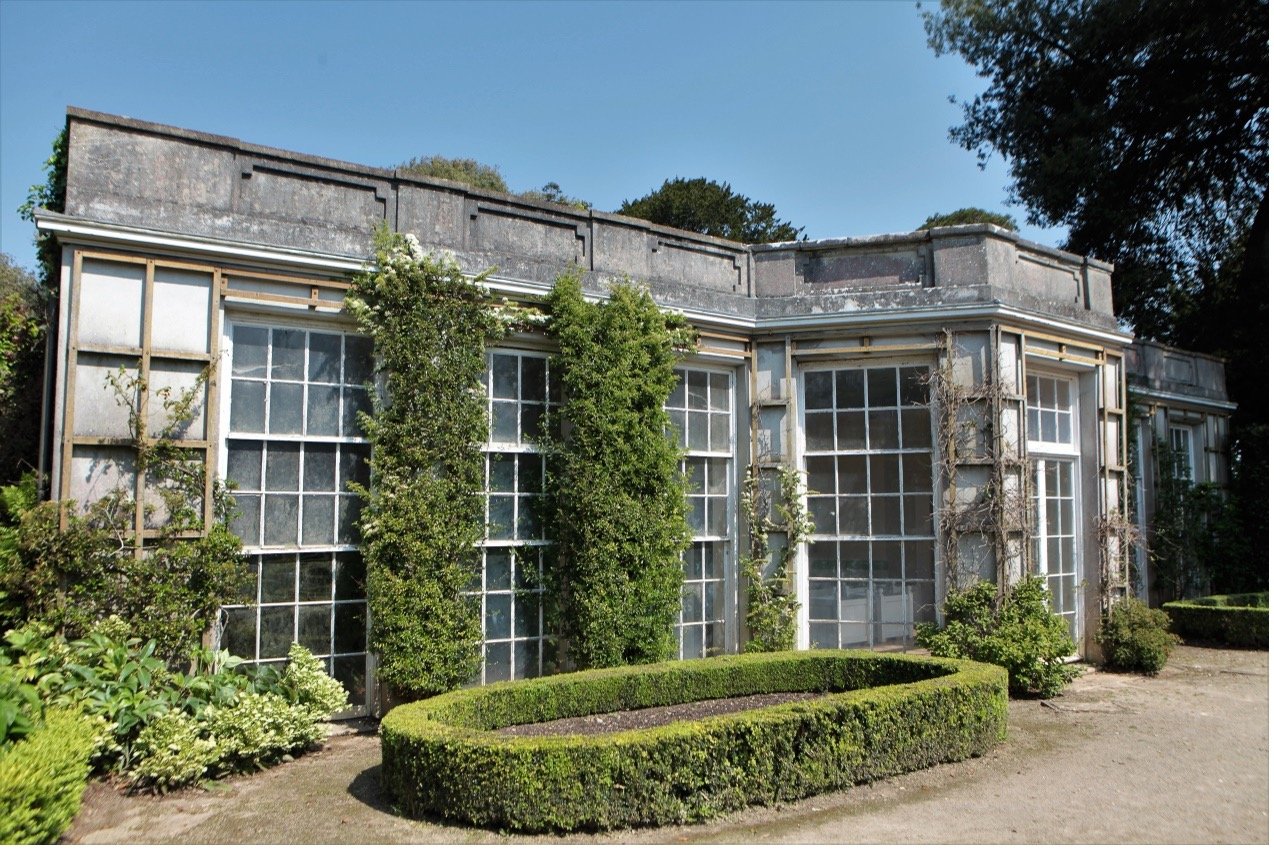
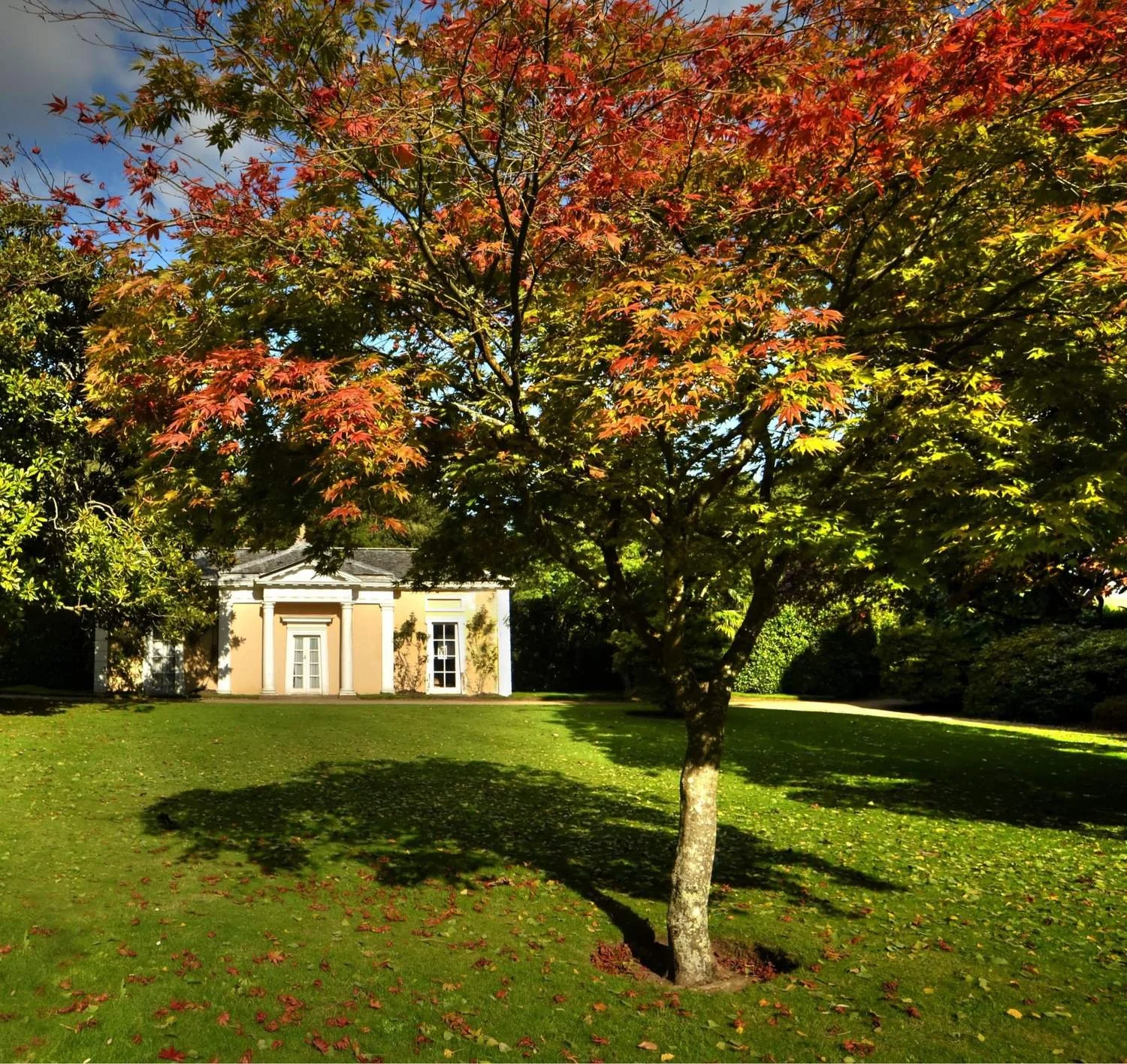
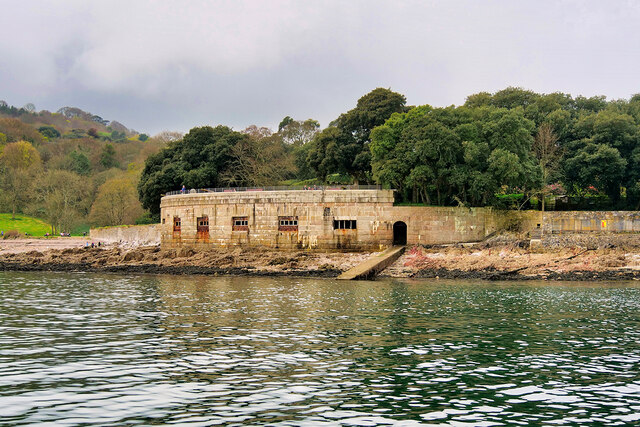
'A Terrestrial Paradise: The Designed Landscape of Mt Edgcumbe in Context'
Chronology of some key events
by Macolm Cross & Kate Feluś
1353. William Edgcumbe (son of Richard Edgcumbe) married Hilaria, the orphan daughter of William de Cotehele. Cotehele lands and house formed her dowry
Royal Barge with Cotehele in the background, Nicholas Condy, 1846
1493. Sir Piers Edgcumbe married Joan, only daughter and heiress of Stephen Durnford. She inherited estates on both sides of the Tamar including East and West Stonehouse.
1515. King Henry VIII granted a Royal licence to embark the deer park.
1549-1553. Sir Richard Edgcumbe had the house constructed by Roger Palmer of Plymouth.
One of the earliest paintings of Mount Edgumbe House, W de Busc 1680
Pre-1643. Walled garden created in the Amphitheatre area.
1644-46. Civil War siege. Sir Piers declared for King Charles and was granted a Colonel’s commission, but Plymouth declared for Parliament. The House was constantly under siege from the Plymouth Garrison, eighty of whom were killed by the defenders. The Dining Hall & Outbuildings were burnt. Colonel Edgcumbe, although undefeated, accepted surrender to Parliamentary forces.
1671. After the restitution of the monarchy, Charles II visited Mount Edgcumbe and again in 1677.
King Charles II of England,
painted in 1653 by Philippe de Campagne
1718. Deer Park still on lower, northern section of landscape, around the house. The high ground behind house still in fields. Pattern of radiating and interconnecting avenues and walks to the north of the house first plotted on a map.
1729. Central part of the English Garden House built
1737. Badeslade’s famous view of Mount Edgcumbe was published in the Badeslade and Rocque's Vitruvius Brittanicus.
Thomas Badeslade 1737
1750. Richard Edgcumbe (1716-1761) brought back orange trees from his travels in Italy.
“The Gardens abound with the finest evergreens I ever saw, the Green house (probably the French Garden House) has the largest and finest Orange Trees in England. There is likewise an Orangery Glazed Walls with flews, against which Orange and Limon Trees are nailed as vines, and bear prodigious Quantities & the greatest perfection.”
1750s. Great Terrace constructed with ornamental archway. Zigzags laid out. Folly built. New Deer Park created in present position.
Lower Zig-Zags,
painted by Nicholas Condy (1793-1857)
1760. Orangery in the Italian Garden built. Thompson’s Seat built c. 1760.
1766. George Edgcumbe (3rd Baron) becomes Commander in Chief of Plymouth. Appointed Vice-Admiral in 1770 and Admiral 1778.
1770. First ice house built (replaced in 1799) and Picklecombe Seat and Shell Seat in the Earl’s Garden built.
Shell Seat in the Earl’s Garden, built ca. 1770 © M. Corber 2023
1775. Kitchen Garden moved from flat area at base of Amphitheatre to new walled gardens at Empacombe.
1779. Threatened invasion by Franco-Spanish navies. Hundreds of trees felled on orders of General Amherst to prevent enemy concealment.
1781. George III and Queen Charlotte visited Mount Edgcumbe and George Edgcumbe appointed Viscount Mount Edgcumbe and Valletort in recognition of his support in 1779.
Queen Charlotte of England,
painted in 1781 by Thomas Gainsborough
1788. Gardens opened to the public (properly attired), normally on Mondays.
1789. George III and Queen Charlotte visit with their daughters. Viscount George Edgcumbe elevated to 1st Earl.
1791. Coade stone monument in the English Garden erected for Timothy Brett. He was Clerk of the Acts in the Royal Navy (a senior civilian post and member of the Navy Board; a post once held by Samuel Pepys). He attended the marriage of George with Emma Gilbert soon after his appointment in 1761.
1803. French Garden and Garden House built.
1812-19. Milton’s Temple built.
Milton’s Temple, here shown c. 1900 when it still contained a statue of Milton. On the wall is an excerpt from Milton’s Paradise Lost:
“Over head up grow
insuperable height of loftest shade,
Cedar , and Fir, and Pine, and branching Palm.
a sylvan scene, and as the ranks ascend,
shade above shade, woody theatre
of stateliest view.”
1827. King William and Queen Adelaide visit and new grotto at Penlee Point dedicated to the Queen.
c. 1840. Alterations to the house by George Wightwick for the new earl (Ernest Augustus 3rd Earl).
1843. Queen Victoria visits. Again in 1846.
1891. Great Blizzard when 2,000 trees were lost in the park.
1906. The estate employed one hundred and seventy two staff to maintain the gardens and park, including thirty two gardeners and eight wood rangers.
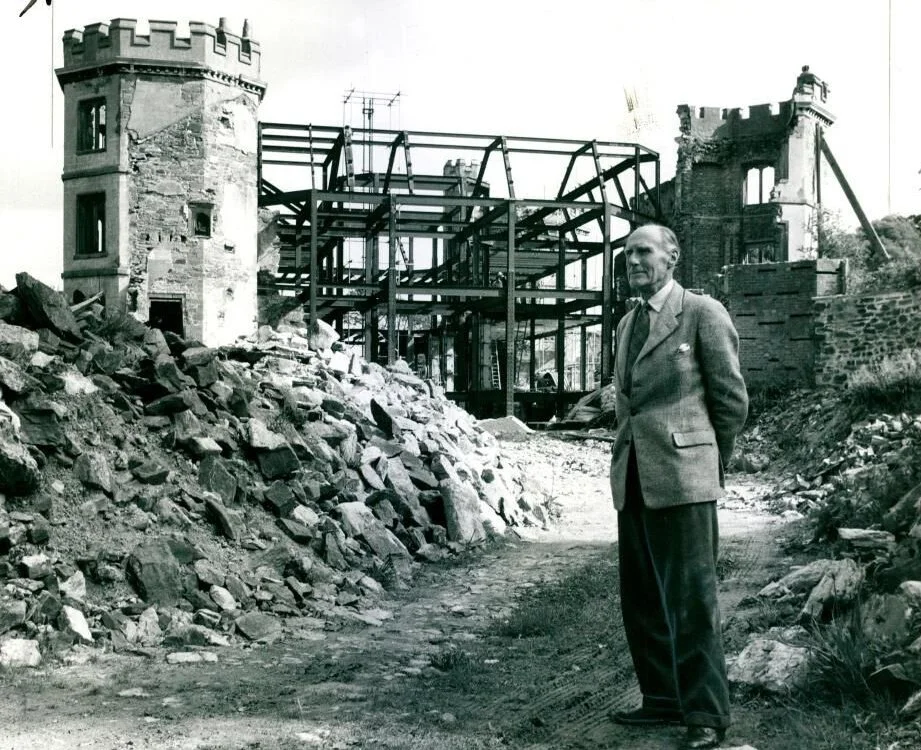
Kenelm Edgcumbe surveys destruction of Mount Edgcumbe House during restoration. c. 1958-59
1941. Mount Edgcumbe House hit by incendiary bomb meant for dockyards. Only shell remained.
1958-64. House rebuilt on a different plan and scale to the original.