
The French Garden House
Research & words by Dr Malcolm Cross
The French Garden House and surrounding garden dates from the very early years of the 19th century. It was the product of collaboration between perhaps the most artistic of the male Edgcumbes and his young wife, Sophia. The garden contained elements of classical formality in the box-bordered parterres but the overwhelming feeling was one of romanticism, with copious trellises bedecked in fragrant climbing plants.
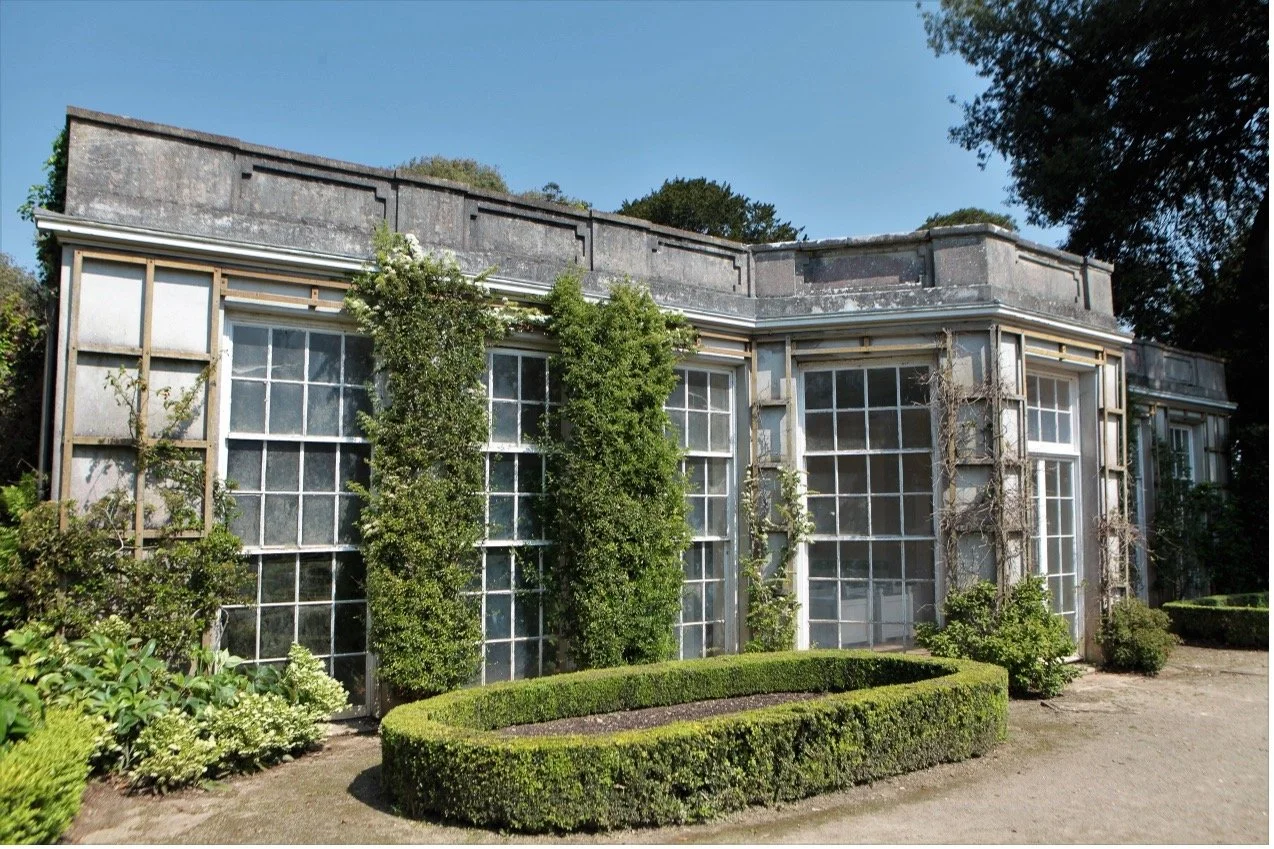
The French Garden House in 2023
The French Garden was created in the early years of the 19th century and influenced greatly by the tastes of Sophia (née Hobart) the wife of Richard the 2nd Earl whose early death in 1806 is commemorated by a classical urn in an alcove to the side of this feature.
The garden itself continues the motif of a return to some elements of classical formalism with box-bordered parterres. It has to be said, however, that this is little more than a nod in that direction since the overall feeling was intended as one of romanticism as the abundant bedecked trellises in the early photograph below show.
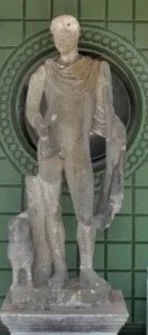
Statue of Mercury. Photo © M. Corber 2023
At this time, parterres were seen as quintessentially French, as was the central feature of the ‘jet d'eau’ springing from a rock base intermixed with shells. This was regarded as the very essence of the French Rococo (derived from rocaille – rocks and coquille - shells).
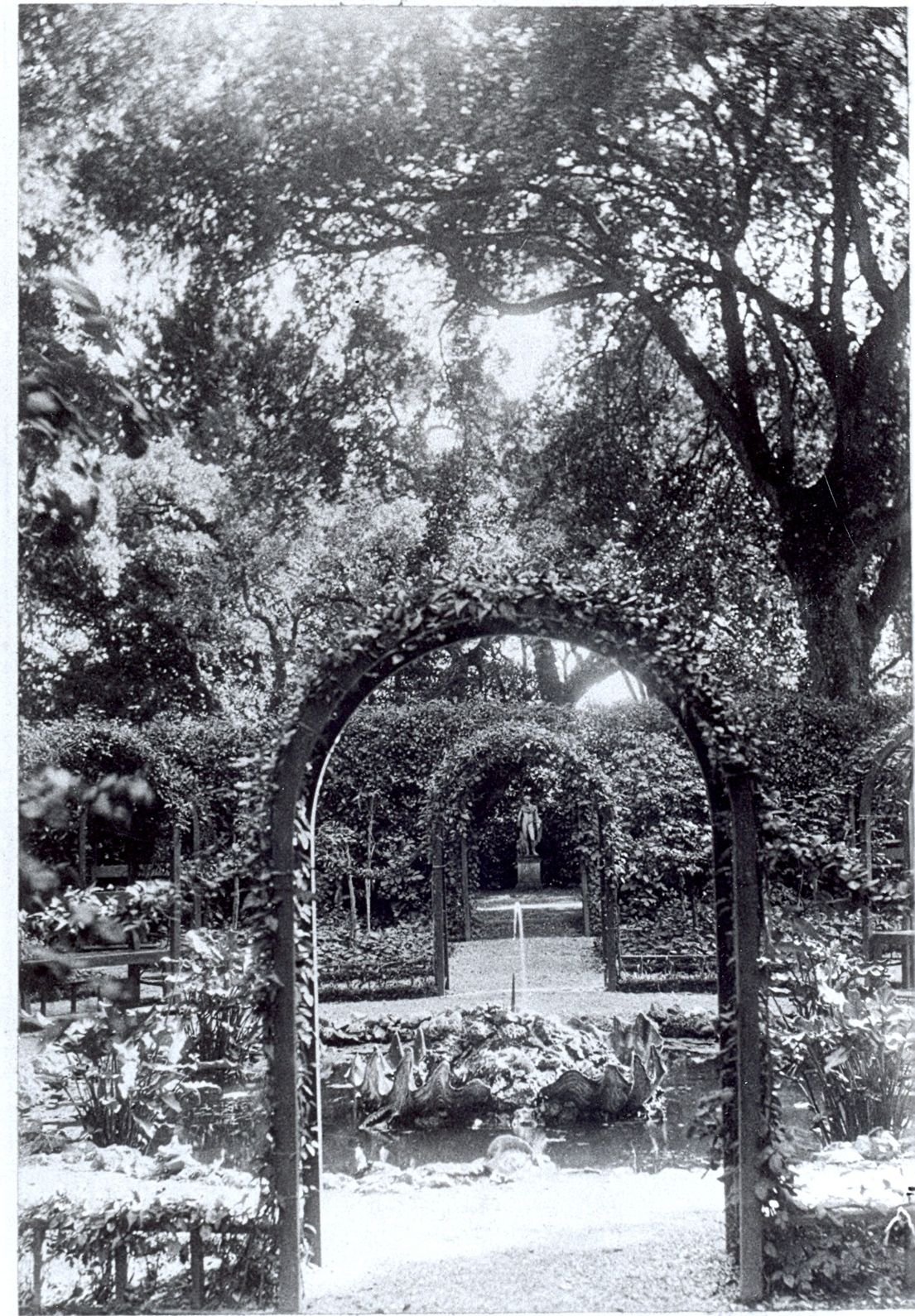
Vintage photo of the French Garden from the Earl’s Collection © Mount Edgcumbe House
Unlike the English Garden House, the French Garden House was never intended as a residence; rather it was intimately connected to the garden itself and was built with plants in mind and in many respects is a form of conservatory. The garden was laid out in the very early years of the 19th century and the building is contemporary with this period. It was the product of collaboration between perhaps the most artistic of the male Edgcumbes and his young wife. Richard, the 2nd Earl followed his mother in being devoted to music but added to her attributes a wider appreciation of the arts in general. He married Lady Sophia Hobart in 1789 and they produced five children before her tragically early death at the age of 38 in 1806.
Sophia played an important role in the design of the garden and after her death an urn was erected with the following inscription:
To the Memory of
Her
whose taste embellished,
whose presence added charms to
these Retreats,
(Herself the brightest Ornament,)
This Urn is erected
In the Spot she loved.
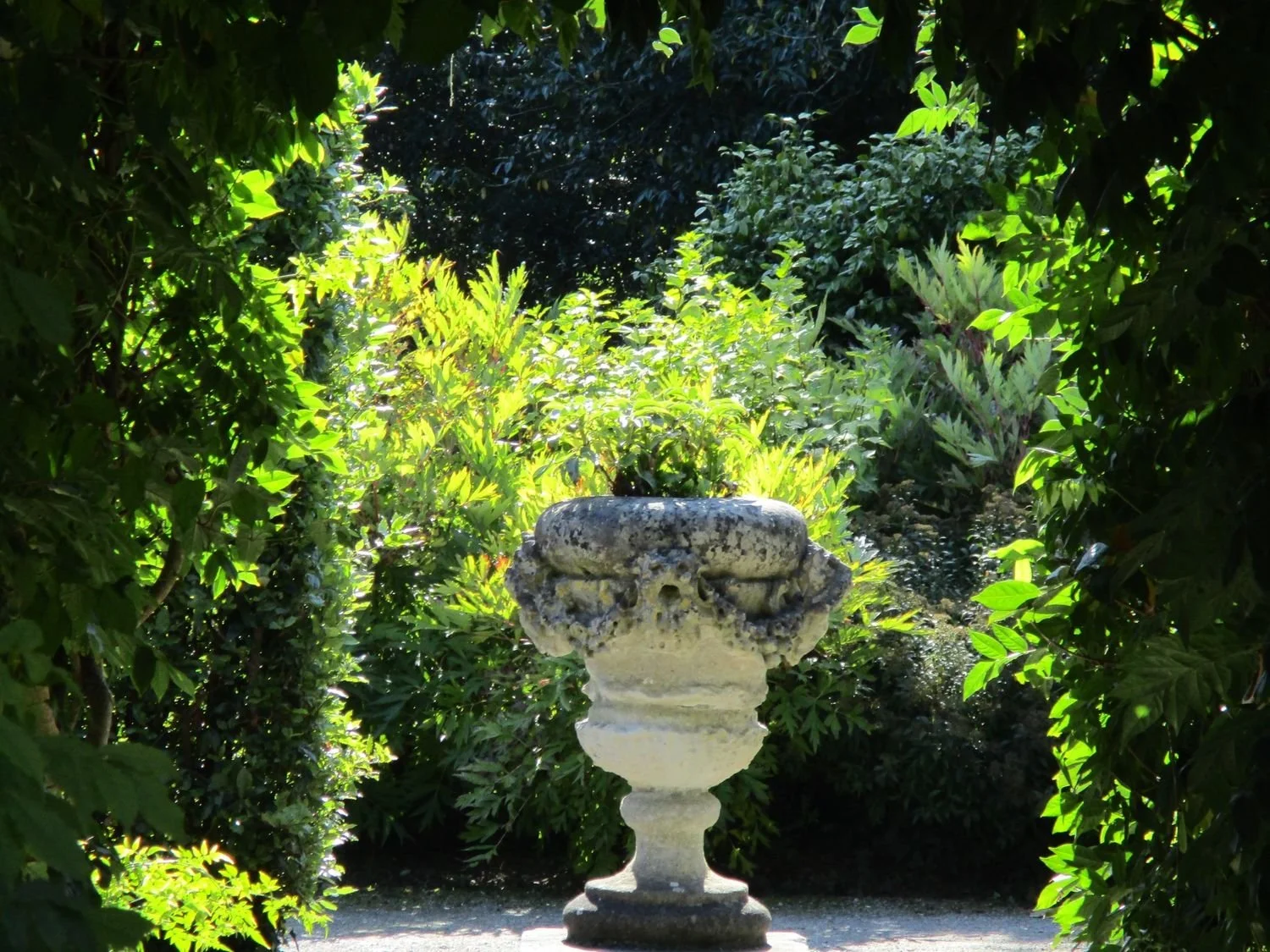
Ornamental urn © Jules 2020
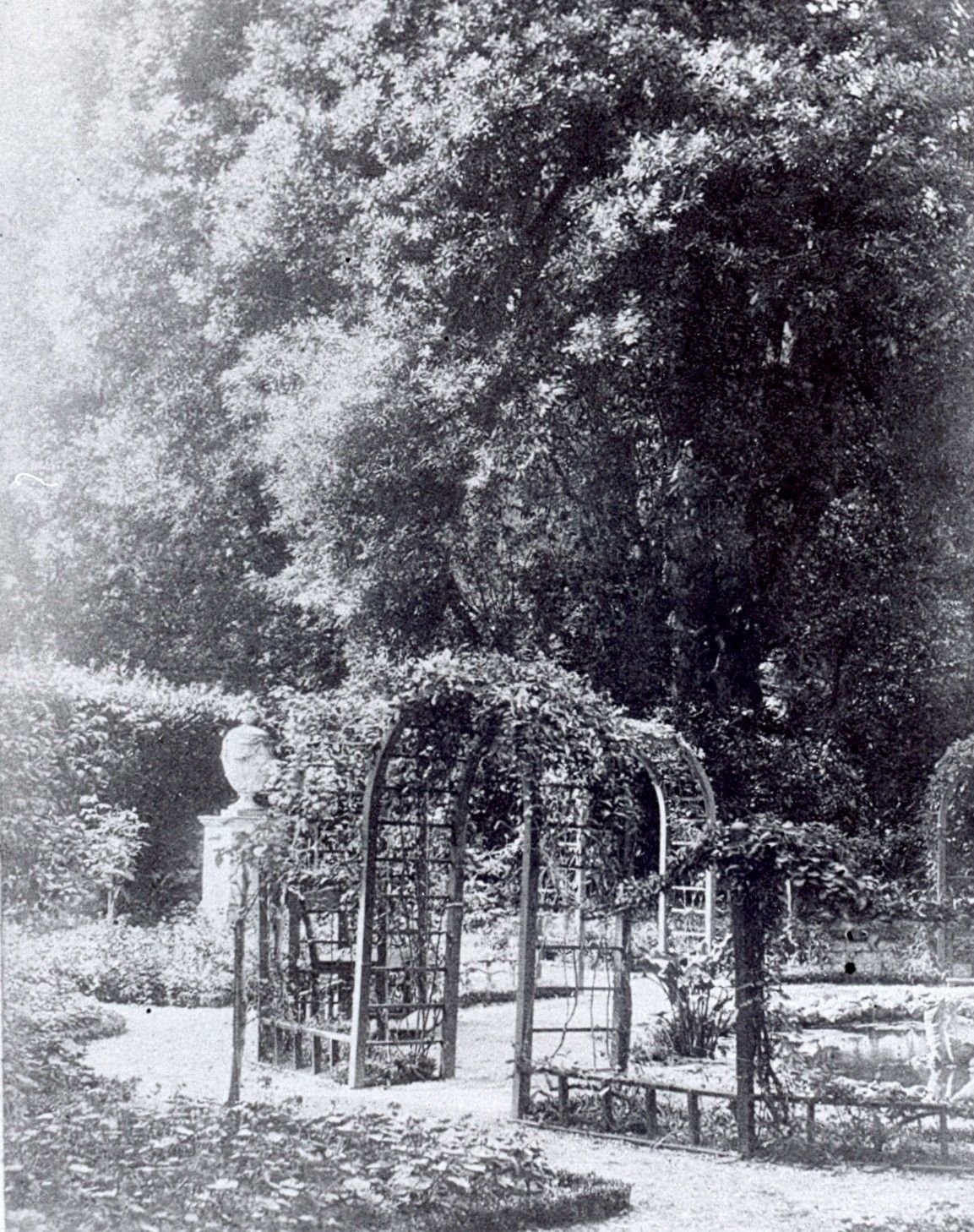
This early photograph from the Earl’s Collection provides some sense of how the romantic sentiment in the French garden was generated. Image © Mount Edgcumbe House
Almost all commentators noted the ingenuity of a carefully constructed device in the octagonal central room. A picture on the rear wall could be lowered to reveal a mirror in front of which was a small antique figure of Meleager; the image was then visually linked through the trellises of scented flowers to the statue of Mercury on the hedge at the rear of the garden. The meaning here is not difficult to discern. In one version of Greek mythology, Meleager was an early instigator of female equality in accepting that his lover Atalanta struck the first blow against the giant boar sent by Artemis to ravage his homeland of Calydon, and thereby welcoming her as an equal to the famous band of hunters that sought revenge. The Roman god Mercury (Hermes in Greek mythology) was a god of fertility and patron of music blessed with the gift of eloquence and considered the speediest of messengers. This is a statement about a happy but sadly brief marriage, marked by a mutual love of the arts and sustained by an unusual level of equality. After Sophia’s death, Richard Edgcumbe cared for their four surviving children and lived on for another 33 years. He never remarried.
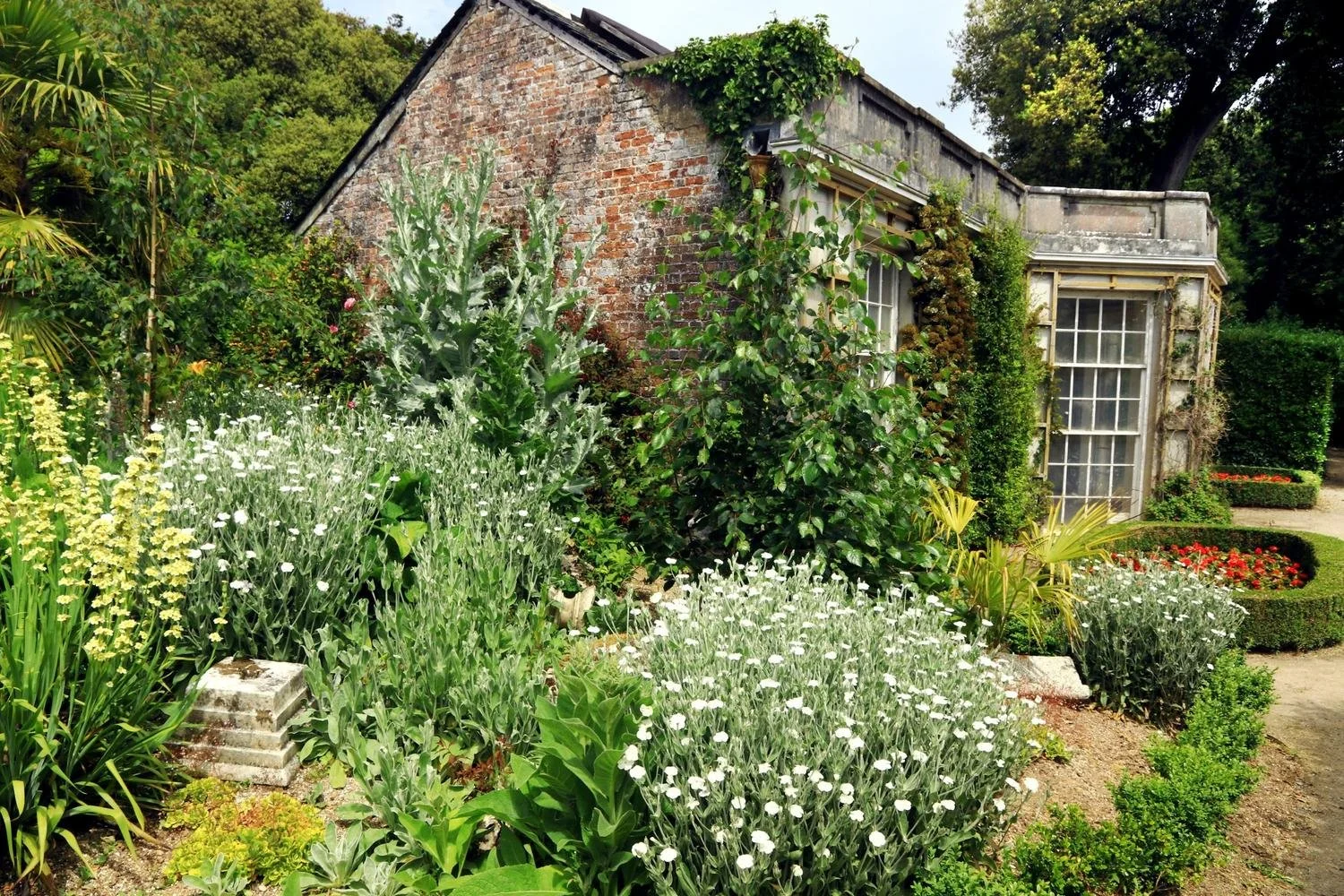
The French Garden House viewed from the side through a mass of foliage © Karl Beeney 2022
References
University of Pennsylvania (2008) English Garden House and French Garden House, Architectural Investigations and Archival Research, Graduate Program in Historical Preservation, School of Design (2 vols) (UoP)
Berry, E. and Herring, P. (2005) ‘Buildings and Conservation Report’, in P. Hughes, Mount Edgcumbe Conservation Plan, 4 volumes, Cornwall Council
Further reading on Buildings & Structures in Mount Edgcumbe Country Park
Bristow, I.C. (1995) Mount Edgcumbe: the English Garden House, Report on an investigation of paint samples for English Heritage, London, 22 June.
Carew, R. (1602 reprinted Tamar Books, 2000) Survey of Cornwall: 113-14.
Chope, R.P. (Ed) (1967) Early Tours in Devon and Cornwall, Newton Abbott, David and Charles.
Cornwall Records Office ME/2031/1) – now housed at Kresen Kernow in Redruth
Jope, E.M. (1961) ‘Cornish Houses’ in Jope E. M. (Ed.) Studies in Building History, London, Odhams Press: 192-222.
Carew, R. (1602 reprinted Tamar Books, 2000) Survey of Cornwall: 113-14.
Feluś, K. et al. (2016) Mount Edgcumbe Parkland Plan, 3 volumes, Cornwall Council
Fiennes, C. (1967) ‘Through England on a Side Saddle’ in Chope (Ed.) Early Tours in Devon and Cornwall, Newton Abbott, David and Charles.: 111-137.
Gaskell Brown, C. and Humphries, R.W. (1993) English Garden House Excavation and Survey.
Gaskell Brown, C. (2003) Mount Edgcumbe House & Country Park: A Guide, 2nd ed. Acanthus Press.
Gilbert, C.S. (1820) A Historical Survey of the County of Cornwall, Plymouth.
Jewitt, L (1873) History of Plymouth, London, Simkin, Marshall and Co.
Jope, E.M. (1961) ‘Cornish Houses’ in Jope E. M. (Ed.) Studies in Building History, London, Odhams Press: 192-222.
Hughes, P. (2005) Mount Edgcumbe Conservation Plan, 4 volumes, Cornwall Council
Kelly, A. (1990) Mrs Coade’s Stone, Reading, Berks, Kelly.
Lipscomb, G. (1799) Journey into Cornwall, Warwick, H. Sharpe.
Land Use Consultants (2000) Mount Edgcumbe: Development of the Historic Landscape and Repair and Restoration Proposals, London, LUC
Pococke, R. (1967) ‘Travels through England’ in Chope (Ed.) Early Tours in Devon and Cornwall, Newton Abbott, David and Charles.: 178 – 215.
Rowe, S. (1832) The Panorama of Plymouth, or Tourists’ Guide to the Towns and Vicinity of Plymouth, Devonport, and Stonehouse, Plymouth.
Thomas, N. and Thorpe, C. (1996) An Archaeological Investigation of Features Associated with the English Garden House, Mount Edgcumbe, Cornwall Archaeological Unit, CCC.
Warner, R. (1812) A Tour Round Plymouth.
Warner, R. (1809) A Tour Through Cornwall in the Autumn of 1808, Bath, R. Cutwell.
Warner, R. (1837) A Walk Round Mount Edgcumbe, 7th Edition, Devonport.
Warner, R. (1841) A Walk Round Mount Edgcumbe, 11th Edition. Devonport, W. Byers.
Wright, W.H.K. (1871) Duprez’s Visitors’ Guide to Mount Edgcumbe, Plymouth, Cove Bros.