
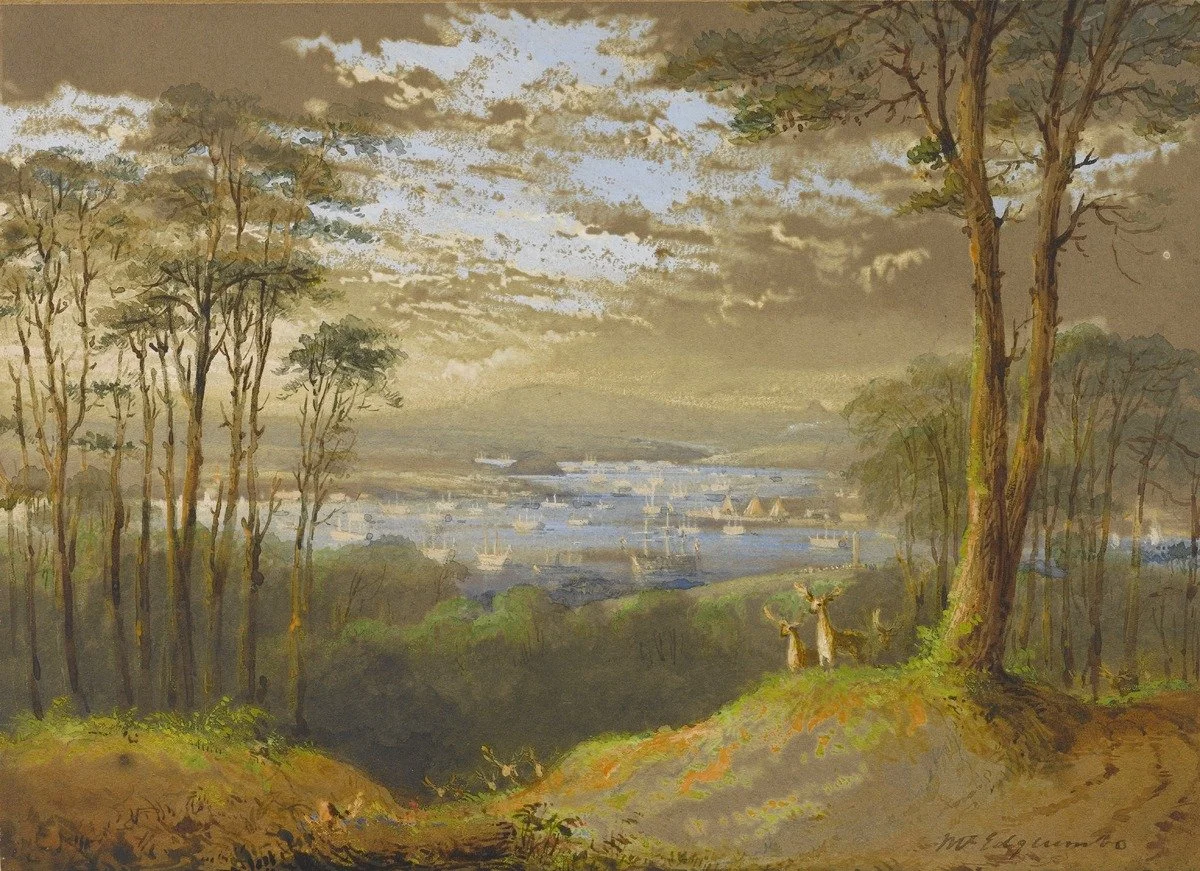
Mount Edgcumbe, Plymouth by Nicholas Matthew Condy (1816–1851) © Royal Albert Memorial Museum & Art Gallery CC0 1.0
“The effect on the mind is sublime in the highest degree, but blended with the beautiful. There was something to us quite unearthly in the feeling it created.”
The Historic Landscape
The historic Mount Edgcumbe landscape created largely in the 18th century covers more than 900 acres or 365 hectares and includes more than 5 miles of coast and riverline. On the way are more than 60 structures listed with Historic England, five scheduled monuments and remains of WWII US military presence. The area is nearly all within the Cornwall National Landscape / Area of Outstanding Natural Beauty.
Mount Edgcumbe Country Park
Photos of Queen Adelaide's Grotto (listed Grade II) © Amanda Slater - CC BY-SA 2.0; Blockhouse from c 1545 (listed II*) © M. Corber 2023; Parterre in formal gardens © M. Corber 2023; Path in Country Park © iwalkcornwall 2025
A substantial part of the historic landscape is now the Mount Edgcumbe Country Park which came into existence in 1971 when the Cornwall Council and Plymouth City Councils purchased 865 acres from the 7th Earl, Edward Piers Edgcumbe. The wars of the 20th century had disastrous repercussions for the Edgcumbe family. In the aftermath of WWI punitive taxes were imposed on landed estates and the Edgcumbe family were among many landowners who then sold off great swathes of land. The WWII saw the destruction of Mount Edgcumbe house by an incendiary bomb intended for the Plymouth dockyard. The 5th Earl, Piers Edgcumbe, died in 1944 without leaving an heir and the title passed to his 70-year old cousin Kenelm, then living in Germany. As the 6th Earl, Kenelm gamely took up the challenge of rebuilding the wrecked house and looking after the parkland that had received no care during the years of war. After Kenelm’s death in 1965 it was his successor, Edward Piers Edgcumbe, who eventually negotiated the sale of the parkland to become a public park. More information about this process, and the early history of the park, is available HERE.
Images: One of the earliest paintings of the Mount Edgcumbe landscape by W de Busc 1680; Mount Edgcumbe House and ornamental garden viewed from the East, ca. 1850; Mount Edgcumbe House and barn at Barn Pool depicted by Prideaux; 1727; postcard of Beech Wood / Lady Emma’s Cottage 1907
The Grade I Landscape
As a result of the National Heritage Act in being passed in April 1984, a ‘Register of Parks and Gardens of Special Historic Interest in England’ was created and Mount Edgcumbe was designated a Grade I listed landscape in June 1987. The listing entry reads:
“An early C16 park which was landscaped in the C18 and early C19, together with C18 and early C19 gardens and pleasure grounds which were partly developed late C17 formal gardens. Extensive late C18 and early C19 coastal rides leading to Penlee Point incorporate a series of picturesque features and structures.” (Historic England list entry for Mount Edgcumbe Park & Garden)
The protected landscape is home to a great number of buildings, seats, structures, statues and monuments, many of which have their own separate listing.
The Rame Head AONB
Drone image of Rame Head © Cyberheritage.co.uk
Most of the Mount Edgcumbe historic landscape falls within the boundaries of the Rame Head Area of Outstanding Natural Beauty (AONB) - Section 11 of the Cornwall National Landscape. Since 2023, AONBs are also referred to as National Landscapes. There are 46 such areas within England, Wales and Northern Ireland and they are safeguarded in the national interest for their distinctive character and beauty. Along with National Parks, AONBs enjoy the highest level of protection in terms of planning. There are 12 AONBs in Cornwall, of which the Rame Head AONB is the smallest.
The spectacular Rame Head promontory that gives the AONB its name falls within the boundaries of the Country Park although it is currently sublet to a local farmer.