
Lambert, Scott & Bampfylde’s view of Mount Edgcumbe from the sea, 1755
The Grade I listed landscape
As a result of the National Heritage Act in being passed in April 1984, a ‘Register of Parks and Gardens of Special Historic Interest in England’ was created. The Garden History Society (now the Gardens Trust) was asked to suggest gardens and landscapes that merited inclusion on the Register. The then President of the Gardens History Society was Mavis Batey (1921-2013), a remarkably talented individual who in addition to being an eminent garden historian and author of numerous books on historic landscapes had served as a code-breaker at Bletchley Park during WWII. With the help of team of young researchers, Mavis Batey prepared an extensive report on the parkland around Mount Edgcumbe House. This report led to the Mount Edgcumbe landscape being designated a Grade I listed landscape in June 1987 (List Entry Number 1000134) MERIT will be publishing Mavis Batey’s report in the near future.
Steve Brett is the copyright holder of this image of Milton’s Temple (listed Grade II*)
“. . within the sweet recesses of this delicious spot one might retire from the world and yet be a Spectator to all its bustle … and in a fairy mirror behold an epitome of the world”
Stone pineapples near Ice House © iwalkcornwall 2025
A Grade I landscape is subject to strict planning protection and any development within, or affecting its setting, requires consultation with Historic England and with the Gardens Trust. In addition to the landscape itself enjoying the highest level of protection available within English law, the designated Grade I area contains a wealth of buildings, structures, statues and monuments that are separately listed as protected heritage assets. A search for ‘Mount Edgcumbe’ on the Historic England website returns more than 100 results.
Among them are the stone pineapples topping piers on the Drive Bridge by the Ice House. These are made of Coade stone, an artificial stone highly resistant to degradation by the elements associated with Eleanor Coade (1733 -1821).
The map above was generated via the Cornwall Council Interactive Map Service. The hatched area on the map marks the Grade I landscape. The blue dot indicates the position of Mount Edgcumbe House.
The area that was awarded a Grade I listing in 1987 includes heritage assets of great interest that were not initially included in the country park. The most important of these consists of the kitchen gardens and associated buildings in private ownership at Empacombe. There is also an area of ancient woodland to the southwest of the deer park on the western side of the road to Picklecombe, which – like Empacombe – is part of the registered Grade I land but is not in the country park.
Photo © David J. Pearson CC BY-NC-SA 2.0
By contrast the registered Grade I landscape excludes a large area to the west of Penlee Point that is in the country park. This includes the iconic site of Rame Head.
A possible reason for its exclusion from the listing is that, while it is owned by the two councils, it is not part of the designed landscape. It is also the case at that the time of Grade I designation being awarded by Historic England, a large part of Rame Head had been leased as grazing land to a local farmer.
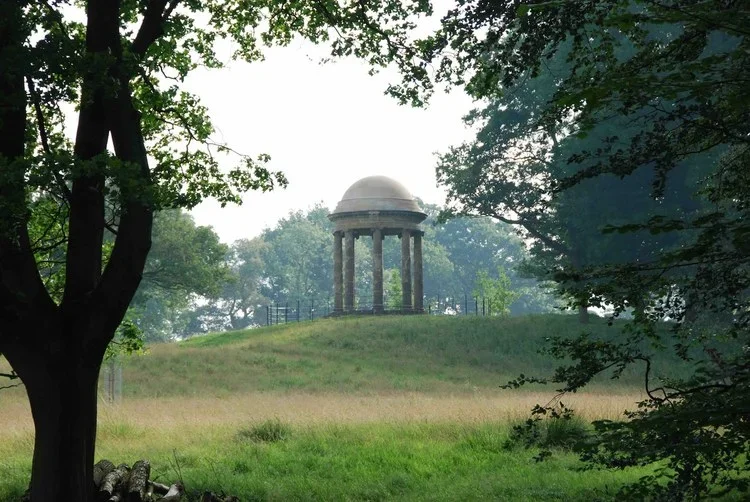
Rotunda at Haley Park © Andrew Nelson 2025
The 'Register of Parks and Gardens of Special Historic Interest in England' includes over 1,700 designed landscapes (such as parks and gardens) assessed to be of particular significance. According to the Gardens, Heritage and Planning blog, as of July 2024 there were 1713 registered parks and gardens, 1106 of which were Grade II, 461 Grade II*, and only 146 are Grade I. This designation signifies that they are of ‘exceptional’ interest, and this is confirmed by their rarity: 8.5% of registered parks and gardens are Grade I. One such is Hagley Park in Worcestershire, recently restored after a century and a half of neglect. The original Hagley Park’s main period of development (from 1747) was under the guidance of George Lyttelton. Research by historian and MERIT trustee Dr Malcolm Cross reveals evidence of contact between the Lyttelton and Edgcumbe families and a number of features are found in both parklands. The accompanying image shows the recently restored rotunda at Hagley Park, not dissimilar to Milton’s Temple on the Mount Edgcumbe Country Park, shown at the top of this page.
More information on the Grade I listed landscape at Mount Edgcumbe, and on the heritage assets it contains, can be found on the Historic England website.