
Mount Edgcumbe House
Research & words by Dr Malcolm Cross
Mount Edgcumbe was tragically burnt to a shell when it was hit by an incendiary bomb intended for the dockyard at Devonport during WW2. The very limited funds available from the war reparations funds, together with the lack of inherited wealth available to the 6th Earl when he took over during the war years, imposed serious constraints on what could be achieved when rebuilding commenced in 1957. The original building, though, was of great historic importance and enough survived to provide an understanding of a design that was at least a generation ahead of its time.
Mount Edgcumbe House 1685 by G. Van Edema (Plymouth City Museum and Art Gallery) (detail)
The house was first built between 1547 and the early years of the following decade by the master mason Roger Palmer of North Buckland, a village that lies between Barnstable and Ilfracombe in North Devon. The covenant for the building works that still survives specifies that he was charged with the task of making ‘all walls, doors, windows, chimneys, stairs, garrets, turrets and arches of new house or lodge in the grounds belonging to Sir Richard Eggecomb, knight’ (CRO ME/2031/1).
The design itself has sometimes been attributed to Italian or French forebears but to all intents and purposes it was a medieval house originally inward looking and with a defensive appearance. This castle-like exterior is vividly shown in the detail from Gerard Van Edema’s (1652-1700) painting from 1685 above. The small windows, both on the round corner towers and the house, itself together with the castellated roof line are clear. What is different from the normal building of this period is the large central double height room instead of an internal courtyard and the most probable influence here was not continental styles but much closer to home at the family seat at Cotehele (cf Jope, E.M., 1961 Studies in Building History: 210-11). Richard Carew, Edgcumbe’s nephew, commenting on the internal layout not long after it was finished says of the great hall that ‘it yieldeth a stately sound as you enter’:
In summer the opened casements admit a refreshing coolness, in winter, the two closed doors exclude all offensive coldness; the parlour and dining chamber give you a large and diversified prospect of land and sea, to which underlie St Nicholas Island, Plymouth fort, and the towns of Plymouth, Stonehouse, Millbrook and Saltash. It is supplied with a never failing spring of water, and the dwelling stored with wood, timber, fruit, deer and conies (1602, Survey of Cornwall, reprinted Tamar Books, 2000: 113-14. Conies are rabbits from the Park’s warren).
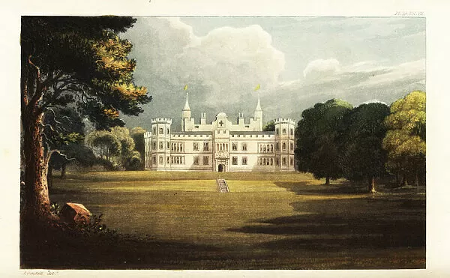
Engraving of Mount Edgcumbe House published in Ackermans’s Repository (R. Ackerman & Co. 1826)
The defensive appearance of the house was by no means unjustified given the local security role played by leading country gentlemen and the rebellious atmosphere in Cornwall at precisely the time the house was being built. Nor were external threats from the seaward side a rarity as the Armada of 1588 was to show. The Civil War also led to attacks by parliamentary forces in 1644 when some of the outbuildings and a banqueting hall to the west of the main house were set ablaze. The latter was rebuilt in 1664 and a new entrance and larger windows were added suggesting a decline in the threat level. A major change in the same direction was implemented by the first Baron Edgcumbe, another Richard, soon after his departure from the government of Sir Robert Walpole in 1744. These were major alterations since the four corner towers that gave the building its castle-like bearing were taken down and replaced with the Gothic, octagonal towers (1747-49) that are still visible today.
Further, mostly internal, changes were made in the late 18th century and the wing to the west was substantially enlarged. The print by Ackerman above shows the almost symmetrical layout of the north façade with its two-storey porch and stone door case containing an armorial carving. The 2nd and 3rd earls continued to make changes. In 1818, Richard, the 2nd Earl hired the Plymouth-born architect, James Adams who made substantial changes to the internal layout. These were very much in the style of John Soane with whom Adams studied for three years from 1806. He entered the Royal Academy Schools in 1808 and, a year later, was awarded the Gold Medal. Richard was particularly keen to add a larger library and a more impressive formal dining chamber to the house and Adams complied with a typically Soane-like elegant design in the form of an oval dining room.
After the death of the 2nd Earl in 1839, his son, Ernest Augustus (1797-1861) lost little time in commissioning another Plymouth-based architect, George Wightwick, to make further improvements, particularly to the gallery on the eastern façade and to the front façade of the earlier western extension. These changes can be readily appreciated from two architectural drawings now in the collection of the Royal Institute of Architects. The first - RIBA35588 - shows Wightwick’s plans of 1843 of the old and new ground and first floors. The changes are significant. The eastern elevation is totally changed with the addition of a stair tower attached to the south-east corner, a two-storey door and porch on the eastern elevation and a further ornamental entrance on the northern frontage of the west wing. The extended drawing room on the eastern end of the building is turned into a garden room by the door to what has come to be called the ‘Earl’s Garden’ and the addition of a conservatory accessed at the south-east corner of the room. The whole feeling of the house becomes less embattled, more domestic and more oriented towards formal entertaining through the enhanced entrance on the western extension.
The Conservatory added in the 1840s. Image from the Earl’s Collection © Mount Edgcumbe House
The extent of the changes to the eastern end of the house are clear from the detail contained in Wightwick’s plan for the Eastern elevation - RIBA25587. Most of Wightwicks’s plan appears to have been implemented as the engraving from some years later shows. The service rooms on the third floor below the central tower are somewhat changed from Wightwick’s design but otherwise the detail is very close to his proposals.
George Wightwick (1802-1872), whose surname is pronounced ‘Wit/tick’, is rarely given the credit he deserves for his contributions to the house. Although born in Scotland, he was another young employee of Sir John Soane and in 1829 joined John Foulston’s practice in Plymouth only six months before the latter retired. He took over the office and completed a number of Foulston’s designs. He is credited with many public buildings in Devon and Cornwall including Luxstowe House in Liskeard and in Plymouth the Town Hall, the Cottonian Library, the Mechanics’ Institute and in Devonport, the Post Office. He was unusual in becoming a journalist and writer on architectural themes, most notably producing Nettleton’s Guide to Plymouth, Stonehouse and Devonport (1836). He would have been well known to Richard the 2nd Earl for like him he was an enthusiastic contributor to amateur dramatics and founded a private literary group called the ‘Blue Friars’.
Eastern Elevation (Morris c. 1880) (Getty Research Institute)
Looking back on the war years, it is apparent that they brought an end to a well- established and overwhelmingly successful Cornish dynasty. The destruction of the house and a significant proportion of its contents in April 1941 was only part of the crisis that befell the family. Piers Edgcumbe, the 5th Earl, died without issue in 1944 and the title diverted to a second cousin Kenelm Edgcumbe who had a distinguished career as an electrical engineer and was the joint owner of a company specialising in military equipment, especially searchlights, but had no strong link with the family or the Cornish estate. He was born in Vienna while his father Richard John Frederick Edgcumbe was born in Hannover (Niedersachsen). In both cases these events were associated with military service and Kenelm’s father was Sergeant-at-Arms to three successive monarchs; Queen Victoria from 1880-1901, Edward VII from 1901-1910 and George V from 1910-1921. It had been agreed that since the 5th Earl was not going to produce an heir that the title should pass to Kenelm’s son, another Piers, but he was tragically killed in May 1940, at Wormhout near Dunkirk while on military duties. Thus it was that the task of settling the future of both Cotehele and Mount Edgcumbe fell to a 71 year-old man with no experience running a large estate or intimate knowledge of the centuries of culture and tradition to which it had given rise. Moreover, there is every reason to suppose that the chalice he was handed was poisoned by a critical lack of resources. The image below captures both the enormity of the task of reconstruction and the less than perfect methods being employed to achieve it.
The house before restoration . The outer walls of the western extension can be seen. Image from the Earl’s collection © Mount Edgcumbe House
In addition to losing the western extension, the most serious loss in the reconstruction was the grandeur of the central saloon with its pinnacled tower. The house now simply looks peculiar with its horizontal roof line and the interior feels more of a pastiche than anything resembling the last reworking of the 19th century. For 400 hundred years, the house was stuccoed in white lime that not only gave it a unique visual significance but also served to protect the limestone rubble walls whose removal has led to a continuing battle with the damp of the Cornish climate.
Mount Edgcumbe House is listed Grade II by Historic England.
References
Cornwall Records Office ME/2031/1) – now housed at Kresen Kernow in Redruth
Jope, E.M. (1961) ‘Cornish Houses’ in Jope E. M. (Ed.) Studies in Building History, London, Odhams Press: 192-222.
Carew, R. (1602 reprinted Tamar Books, 2000) Survey of Cornwall: 113-14.
Gaskell Brown, C. (2003) Mount Edgcumbe House & Country Park: A Guide, 2nd ed. Acanthus Press.
Further reading on Buildings & Structures in Mount Edgcumbe Country Park
Bristow, I.C. (1995) Mount Edgcumbe: the English Garden House, Report on an investigation of paint samples for English Heritage, London, 22 June.
Carew, R. (1602 reprinted Tamar Books, 2000) Survey of Cornwall: 113-14.
Chope, R.P. (Ed) (1967) Early Tours in Devon and Cornwall, Newton Abbott, David and Charles.
Feluś, K. et al. (2016) Mount Edgcumbe Parkland Plan, 3 volumes, Cornwall Council
Fiennes, C. (1967) ‘Through England on a Side Saddle’ in Chope (Ed.) Early Tours in Devon and Cornwall, Newton Abbott, David and Charles.: 111-137.
Gaskell Brown, C. and Humphries, R.W. (1993) English Garden House Excavation and Survey.
Gilbert, C.S. (1820) A Historical Survey of the County of Cornwall, Plymouth.
Jewitt, L (1873) History of Plymouth, London, Simkin, Marshall and Co.
Jope, E.M. (1961) ‘Cornish Houses’ in Jope E. M. (Ed.) Studies in Building History, London, Odhams Press: 192-222.
P. Hughes (2005) Mount Edgcumbe Conservation Plan, 4 volumes, Cornwall Council
Kelly, A. (1990) Mrs Coade’s Stone, Reading, Berks, Kelly.
Lipscomb, G. (1799) Journey into Cornwall, Warwick, H. Sharpe.
Land Use Consultants (2000) Mount Edgcumbe: Development of the Historic Landscape and Repair and Restoration Proposals, London, LUC
Pococke, R. (1967) ‘Travels through England’ in Chope (Ed.) Early Tours in Devon and Cornwall, Newton Abbott, David and Charles.: 178 – 215.
Pye, A. and Woodward, F. (1996) The Historic Defences of Plymouth, Truro: Cornwall County Council
Rowe, S. (1832) The Panorama of Plymouth, or Tourists’ Guide to the Towns and Vicinity of Plymouth, Devonport, and Stonehouse, Plymouth.
Thomas, N. and Thorpe, C. (1996) An Archaeological Investigation of Features Associated with the English Garden House, Mount Edgcumbe, Cornwall Archaeological Unit, CCC.
Warner, R. (1812) A Tour Round Plymouth.
Warner, R. (1809) A Tour Through Cornwall in the Autumn of 1808, Bath, R. Cutwell.
Warner, R. (1837) A Walk Round Mount Edgcumbe, 7th Edition, Devonport.
Warner, R. (1841) A Walk Round Mount Edgcumbe, 11th Edition. Devonport, W. Byers.
Wright, W.H.K. (1871) Duprez’s Visitors’ Guide to Mount Edgcumbe, Plymouth, Cove Bros.